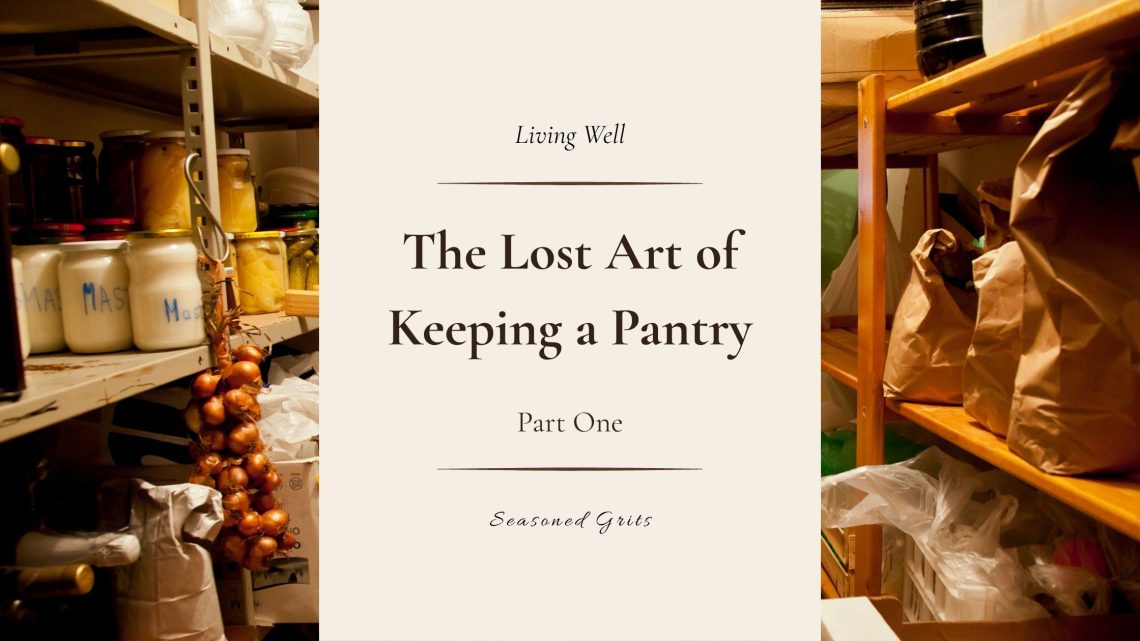
The Lost Art of Keeping a Pantry: Part 1
Part One: When Being Prepared Was Just Common Sense
When I was growing up, nobody called it “prepping.”
We didn’t have emergency food buckets stacked in the garage, survival food advertised on television, or a carefully calculated three-month supply of freeze-dried meals.
We had a pantry.
In our house, it was actually a small room of its own. It housed the washer, ice box, and lots of sturdy shelves. Looking back now I realize what a practical little space it was.
There were shelves lined with canned vegetables, jars, flour, sugar, cornmeal and whatever else my mother knew we would eventually use. You didn’t wait until you were completely out of something to buy another one. Green beans went on the grocery list before you opened your last can.
Nobody made a YouTube video about it.
It was just housekeeping.
And somewhere along the way, I think we lost a little of that wisdom.
A Pantry Wasn’t About Fear
This may be the biggest difference between then and now.
Keeping extra food in the house wasn’t necessarily about preparing for some terrible event. It was about preparing for Tuesday.
Maybe somebody got sick.
Maybe the weather was bad.
Maybe money was a little tight that week.
Maybe company showed up unexpectedly.
Or maybe Mama simply didn’t feel like making a trip to the grocery store.
A reasonably stocked pantry meant there was almost always something in the house from which you could make a meal.
That’s a very different philosophy from buying food out of fear.
It’s simply planning ahead.
And our mothers and grandmothers were awfully good at it.
What Was Actually in Those Pantries?
Of course, every household was different, and where you lived made a difference too. A farm family might have had shelves filled with home-canned vegetables while a family in town relied more heavily on commercially canned foods.
But there were certain workhorses that showed up again and again.
There were baking basics such as flour, sugar, cornmeal, baking powder, baking soda and shortening. There were dried beans, rice, oatmeal and pasta. Canned tomatoes and tomato sauce were useful for all sorts of meals.
Then came the canned vegetables: green beans, corn, peas, carrots and whatever the family regularly ate.
There might be canned peaches, pears or applesauce. Jams, jellies and preserves. Pickles and relishes.
Peanut butter.
Evaporated milk.
Canned soup.
Coffee and tea.
Salt, pepper, and basic seasonings.
Potatoes and onions were often kept somewhere cool and dark. Ours were stored in paper bags under the bottom shelf.
And if the family gardened, there might be row after row of Mason jars filled during the summer and enjoyed all winter.
Home food preservation was still very much part of American household life in the middle of the last century. Although refrigeration and commercially canned and frozen foods gradually reduced the amount of home canning after World War II, USDA records show that families were still routinely preserving fruits, vegetables, jams, jellies, pickles and other foods well into the 1950s and ’60s.
There was something wonderfully sensible about it:
You stocked what your family ate.
Not what somebody on the Internet told you that you ought to have.
The Pantry Was Part of a Larger Rhythm
I think this is the part that’s easiest to overlook.
The pantry wasn’t really a separate household project. It was connected to the way people lived.
Strawberries came in season? You made jam.
Tomatoes were coming faster than you could eat them? You canned tomatoes.
The garden produced more green beans than you needed for supper? You put some up for winter.
Peaches were plentiful and inexpensive? You bought extra and preserved them.
Food wasn’t quite as disconnected from seasons as it is today.
Today we walk into a supermarket in January and expect to find strawberries, tomatoes, lettuce, blueberries and practically anything else our hearts desire.
That’s convenient, and I’m certainly not suggesting we give it up. I happen to enjoy modern conveniences just as much as the next woman.
But convenience has a sneaky little way of convincing us that something will always be available simply because it is available today.
Our mothers and grandmothers weren’t necessarily thinking that way.
They knew seasons changed.
They knew prices changed.
They knew circumstances changed.
So when something was plentiful, you took advantage of it.
There was wisdom in that.
Then Came the Modern Kitchen
After World War II, American kitchens began changing rapidly.
Refrigerators and home freezers became increasingly common. Supermarkets offered more canned, frozen and processed foods. Manufacturers introduced an ever-growing assortment of labor-saving appliances and convenience foods.
The kitchen itself began changing too.
By the 1950s and ’60s, the “modern kitchen” had become something of a status symbol. Manufacturers and home builders promoted sleek cabinetry, new appliances and efficient spaces as signs of progress.
And progress wasn’t necessarily bad.
Goodness knows, I’m grateful for my refrigerator, freezer, dishwasher and all the other conveniences that make life easier.
But gradually, the old-fashioned pantry began disappearing from many homes.
We gained convenience.
We gained beautiful kitchens.
We gained the ability to buy practically anything we needed with a quick trip to the grocery store.
And perhaps we began losing the habit of keeping a little ahead.
We Didn’t Call It Stockpiling
This is where I think today’s conversation about “prepping” can sometimes make something very ordinary sound rather extreme.
There’s a pretty big stretch between having twelve cans of green beans in the pantry and preparing for the collapse of civilization.
I’m talking about the green beans.
Keeping a pantry doesn’t mean buying 47 cans of something your husband won’t eat simply because they were on sale.
It doesn’t mean filling every closet in the house with toilet paper.
And it certainly doesn’t mean spending money you don’t have in order to prepare for every conceivable emergency.
The pantry I remember was much more practical than that.
Buy a little extra when the price is good.
Keep staples on hand.
Replace what you use.
Preserve what you grow when you can.
Know what you have.
And use the oldest things first.
That’s not panic.
That’s good stewardship.
Maybe Grandma Knew Something After All
There’s a reason I find myself thinking more about this lately.
Food costs more than it used to. A quick trip into the grocery store for “just a few things” can produce a receipt that makes you wonder whether you accidentally purchased part ownership in the store.
And many of us now live in houses with kitchens that are absolutely beautiful…but apparently designed for people who own three cans of soup and a decorative bowl of lemons.
Where exactly are we supposed to put anything?
That’s where this old-fashioned idea becomes surprisingly useful again.
Maybe we don’t need to recreate our grandmothers’ pantries exactly.
Maybe we don’t have a little room with shelves from floor to ceiling.
And maybe we aren’t interested in spending August standing over a pressure canner putting up 75 quarts of green beans.
That’s okay.
The principle still works.
Keep enough useful food in your home that you can feed your family without depending on a trip to the store every other day.
Buy what you actually eat.
Take advantage of good prices when you can.
Keep basic ingredients from which you can make simple meals.
And think a little further ahead than tonight’s supper.
It isn’t flashy.
It doesn’t require a new lifestyle.
And it certainly isn’t new.
In fact, it’s about as old-fashioned as it gets.
Maybe that’s exactly why it’s worth bringing back.
Coming in Part Two: Building a Modern Pantry When You Don’t Have a Pantry
Most of us aren’t working with Grandma’s pantry room anymore. We have cabinets, awkward corners, shallow shelves and kitchens where storage seems to have been sacrificed in the name of looking pretty.
So in Part Two, we’re going to get practical.
We’ll talk about how to build a useful pantry a little at a time, what foods are worth keeping on hand, how to find storage space in a modern home, how to rotate what you buy, and how a well-planned pantry can help soften the impact of rising grocery prices.
No panic buying.
No 25-year supply of powdered eggs.
Just some good old-fashioned common sense adapted for the way we live now.
I think our mothers and grandmothers would approve.

You May Also Like

5 Reasons Life After 60 Is Better With Pets

Welcome to Seasoned Grits: A blog for women aging with grace and grit.