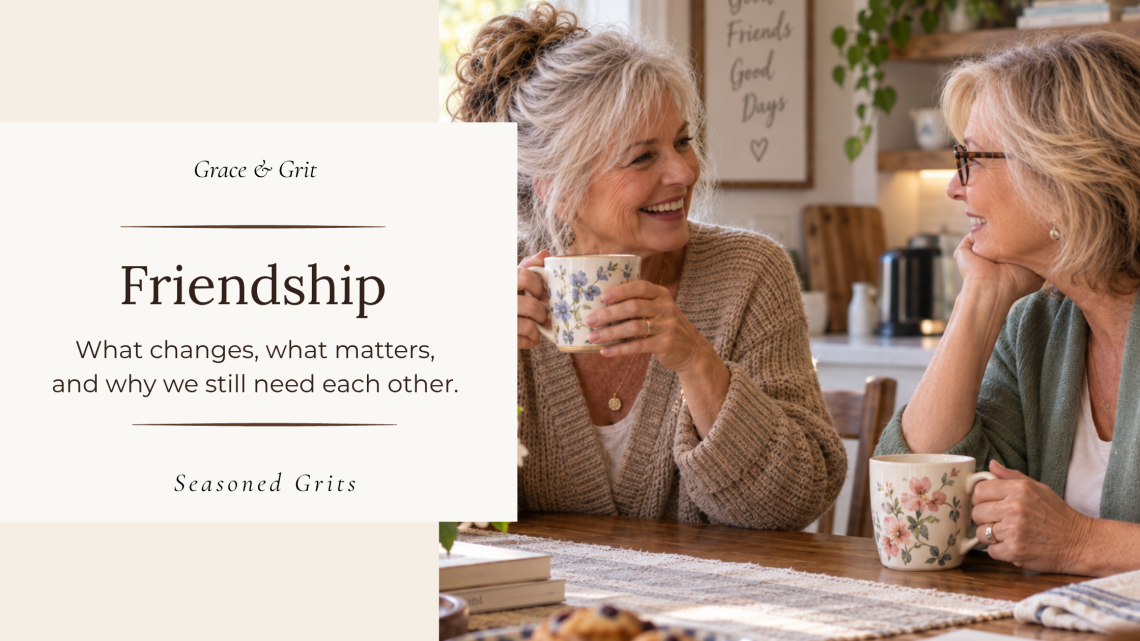
Things No One Told Me About Friendship After 60
I suppose I thought friendship would get easier as I got older.
After all, by 60 we should have this figured out, right?
We’ve survived high school cliques, college roommates, workplace friendships, neighborhood friendships, church friendships, friendships formed while raising children, and probably at least one friendship that left us wondering, What in the world just happened?
Surely by this age we would have accumulated a comfortable little circle of people who know us well enough to overlook our quirks and love us anyway.
Except life doesn’t always work that way.
Friendship after 60 can be wonderful. It can also be surprisingly complicated, occasionally lonely, and very different from friendship at 30 or 40.
There are a few things no one really warned me about.
Some Friendships Quietly Disappear
Not every friendship ends with an argument.
Sometimes there isn’t a dramatic falling-out or an angry conversation. Nobody slams a door.
You simply stop being part of each other’s everyday lives.
Someone moves. Someone retires. Children grow up. Churches change. Health problems interfere. A spouse becomes ill. One person becomes a caregiver. Another begins traveling.
The things that once naturally brought you together disappear.
And one day you realize someone who used to know the ordinary details of your life now knows almost none of them.
There can be real grief in that.
We tend to think grief belongs to death, but I think we grieve relationships too—even relationships that simply faded because life changed.
That doesn’t mean the friendship wasn’t real.
Some people are given to us for a season, and what they brought into our lives during that season still matters.
You May Have Fewer Friends—and Care Less About It
When I was younger, having a lot of friends somehow seemed important.
These days?
I’m much more interested in having a few people with whom I can be completely myself.
There is something wonderfully freeing about reaching an age when you no longer feel the need to maintain relationships simply because you’ve maintained them for years.
I don’t need a packed social calendar.
I need people I can laugh with. People I can be quiet with. People who don’t require me to pretend everything is fine when it isn’t.
At this age, quality wins by a landslide.
Friendship Requires More Intention Than It Used To
When we were younger, friendship often happened almost accidentally.
We sat beside someone at work every day. Our children played together. We stood beside the same women at soccer practice. We served on the same committee at church.
Life kept putting us in the same places.
After retirement, empty nests, moves, health changes and changing routines, those built-in opportunities may disappear.
That means friendship requires something we may not be accustomed to giving it:
intention.
We have to make the phone call.
Send the text.
Suggest lunch.
Invite someone over even though the house isn’t perfectly clean.
And sometimes we have to be willing to be the person who reaches out first—more than once.
That can feel surprisingly vulnerable at 60-something.
Apparently, we never completely outgrow wondering, What if she doesn’t want to be my friend?
Health Changes Friendship
This is something I don’t think we talk about enough.
By our 60s, many of us are living with bodies that occasionally—or frequently—refuse to cooperate with our plans.
Fatigue happens. Pain happens. Doctor appointments happen. Sometimes we cancel plans we genuinely wanted to keep.
A good friend learns the difference between “I don’t want to come” and “I simply don’t have it in me today.”
And what a gift that is.
There is something deeply comforting about a friend who doesn’t require a lengthy explanation.
“I’m having a rough day.”
That’s enough.
Maybe friendship at this age isn’t always about doing things together.
Sometimes it’s simply about being understood.
Longtime Friends Become Keepers of Our History
There is something precious about a person who remembers who you were before you became who you are now.
She remembers your children when they were little. Heck, she remembers when YOU were little.
She remembers the house you lived in, the job you hated, the dream that didn’t work out and the season you weren’t sure you were going to survive.
You don’t have to explain the backstory because she is part of the backstory.
As we get older, those friendships become increasingly valuable.
They remind us that our lives are not just the chapter we’re living today.
We’ve lived a whole book.
And someone else remembers some of the pages.
New Friends Can Still Surprise You
I think one of the biggest mistakes we can make after 60 is believing all our important relationships should already be established.
Why?
We’re still growing. We’re still changing. We’re still meeting people.
The woman who becomes a dear friend at 67 may be someone you haven’t even met yet.
I love that thought.
New friendships don’t erase old ones. They simply remind us that God is still bringing people into our lives.
Sometimes the friend we need for this season couldn’t have walked beside us in the last one because neither of us had become these women yet.
Some Friendships Need to Be Released
Age doesn’t automatically make every relationship healthy.
Sometimes getting older simply gives us enough wisdom to finally recognize what we’ve been tolerating.
One-sided relationships.
Constant criticism.
Competition disguised as friendship.
Relationships that leave us exhausted every single time.
Grace doesn’t require us to give everyone unlimited access to our lives.
We can forgive someone and still recognize that the relationship needs boundaries.
We can love someone and stop chasing them.
We can appreciate what a friendship once was without forcing it to remain what it used to be.
That’s not bitterness.
Sometimes that’s wisdom.
Friendship Doesn’t Always Look Like It Used To
At this stage of life, friendship may be less about long afternoons together and more about a ten-minute phone call.
It might be sending a funny meme because you know exactly who will appreciate it.
It might be sitting beside someone in a waiting room.
Dropping off soup.
Praying for a friend’s husband.
Remembering the anniversary of a loss.
Sending a text that simply says, “You crossed my mind today.”
Maybe we’ve been measuring friendship by the wrong things.
Frequency isn’t always the same as closeness.
Some people can walk back into our lives after months apart and somehow the conversation simply continues.
Those friendships are treasures.
Loneliness Can Sneak Up on Us
We can have families who love us, a church community, neighbors, Facebook friends and people we talk to regularly—and still feel lonely.
There is no shame in admitting that.
Sometimes what we’re missing isn’t people.
It’s connection.
Someone who knows what’s really going on underneath the “I’m fine.”
Someone who asks the second question.
Someone who notices when we’ve gone quiet.
And if we’re longing for that kind of friendship, perhaps someone else is too.
Maybe instead of waiting to be noticed, we can become the person who notices.
We Still Need Each Other
One thing age has taught me is that independence is somewhat overrated.
We spend much of our younger lives proving we can handle things ourselves.
Then life has a way of reminding us that we were never really meant to.
Scripture says:
“Two are better than one, because they have a good return for their labor: If either of them falls down, one can help the other up.”
— Ecclesiastes 4:9–10
We need people who will help us up.
And we need the privilege of helping someone else up too.
Friendship isn’t just about having someone to go to lunch with.
It’s about bearing witness to one another’s lives.
It’s saying, I see you. I remember. I’m still here.
Maybe Friendship After 60 Is Supposed to Be Different
Perhaps the goal isn’t to recreate the friendships we had at 25.
We’re not those women anymore.
We’ve lived enough life to know that people disappoint us. We disappoint people. Seasons change. Relationships change.
But we’ve also learned something about grace.
We know how precious it is to have someone who doesn’t need us to perform.
Someone who can sit with us in the messy middle.
Someone who celebrates the good without competing and stays nearby when life gets hard.
And perhaps we’ve finally learned how to offer that kind of friendship ourselves.
Friendship after 60 may involve fewer people, fewer activities and fewer expectations.
But it can also hold more honesty.
More compassion.
More grace.
And maybe that’s the kind of friendship we’ve been growing toward all along.

You May Also Like

5 Reasons Life After 60 Is Better With Pets

The Lost Art of Keeping a Pantry: Part 1